
 ChatGPT
 Claude
 Perplexity
 Gemini
 Grok
Grok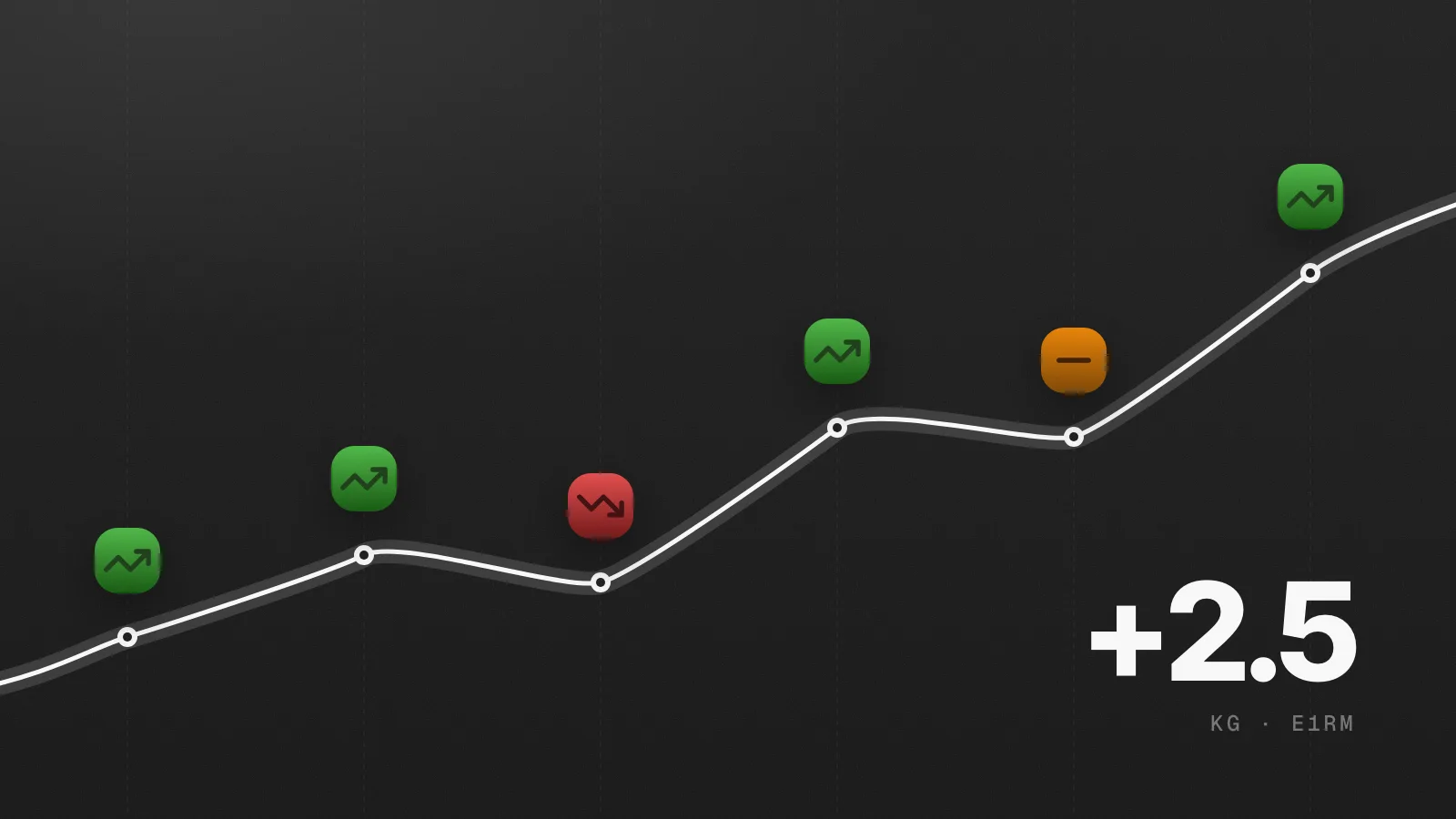
After a couple of years of training, progress stops being visible from one workout to the next. You don't add 5 kg to your bench every month anymore. Gains show up in small increments, spread over weeks, and they're easy to miss entirely if you're not writing anything down.
That's the whole case for tracking. Not because logging is fun, but because past a certain level, it's the cheapest and most reliable lever you have left.
Why tracking is the number one driver of progress
Muscle and strength respond to one thing above all: doing slightly more than before, repeated over months. More weight, more reps at the same weight, more sets. That's progressive overload, and everyone agrees on it.
Here's the part people skip: progressive overload requires knowing what "before" was. You can't beat what you did last time if you don't know what you did last time. Your memory is not up to the job. A typical week is three or four workouts, each with five or six exercises, each with three or four sets. That's 60 to 100 numbers per week. Nobody holds that in their head, and nobody holds it accurately for a month.
Without a log, you end up doing roughly the same weights for months, feeling like you're working hard, and wondering why nothing changes. The work is real. The overload isn't.
What should you track at the gym?
Less than you think. For each working set, write down the weight and the reps. That's the whole core of it.
A few refinements that earn their place:
- Mark your warm-up sets as warm-ups. They shouldn't pollute your comparisons or your volume counts. 60 kg for 10 easy reps before your top set is not data about your progress.
- Note the variation precisely. "Incline dumbbell press 30 degrees" and "incline dumbbell press 45 degrees" are different exercises. If the log mixes them, the numbers stop meaning anything.
- An occasional short note when something unusual happens: a tweaky shoulder, a new grip, a spotter on the last rep. Only when it changes how to read the number.
What you don't need: daily mood scores, bar speed, a rating for every set. Every extra field you add is friction, and friction is what kills logging habits. A log you actually fill in beats a detailed log you abandon in three weeks.
How to track workout progress: the three methods
Your memory: the illusion of tracking
"I remember my numbers" is the most common method and the least honest one. You remember your best sets, roughly, on your favorite lifts. You don't remember set 3 of Romanian deadlifts from eleven days ago, and that's precisely the number you'd need to beat today. Memory also flatters: it rounds up, forgets bad days, and blends workouts together.
Paper or a notes app: real tracking, real friction
A paper notebook or Apple Notes is a legitimate log. Plenty of strong people have trained this way for years. The data is there, it's honest, and it's yours.
The problems are practical. Mid-workout, digging out last week's numbers means scrolling and hunting. Entry is slow with one free hand and 15 seconds of rest left. The data is also trapped as free text. You can't chart three months of progress or count your weekly sets without doing it by hand. We wrote a full breakdown of where this approach breaks down in why Apple Notes isn't enough anymore.
A dedicated log app: same data, none of the friction
A purpose-built log does three things a notebook can't:
- It shows you last workout's numbers while you're logging this one. This is the killer feature, because it's exactly the information progressive overload runs on. In Gymmy, your previous performance sits in grey right where you're typing, so beating it is a decision, not a research project.
- It makes entry nearly instant: a couple of taps for weight and reps, one tap to duplicate a set.
- It turns your history into something readable: a progress chart per exercise, records detected as they happen, weekly volume counts.
The point isn't the app itself. The point is that the method you'll still be using in a year is the one with the least friction.
How to read your training data without fooling yourself
Collecting numbers is half the job. Reading them well is the other half.
Compare against your last workout, not your all-time best
Day to day, the only comparison that matters is what you did last time on this exercise. Match it or nudge it. Chasing your all-time record every workout is a recipe for frustration, because records are outliers by definition.
Judge trends over weeks, not single workouts
Zoom out monthly. Is the chart on your main lifts drifting up over 8 to 12 weeks? Then you're progressing, even if individual workouts bounce around. One useful trick: compare sets at different rep counts through estimated 1RM rather than raw weight. 100 kg for 6 and 105 kg for 4 are hard to compare directly; their estimated max makes them comparable. We covered how that works in our article on the Epley formula.
One bad workout means nothing
Poor sleep, work stress, training at an odd hour, a skipped meal. Any of these can knock 5 percent off your numbers for a day. If you scrap your program every time a workout disappoints, you'll never stay on anything long enough for it to work. Log the bad one honestly and move on.
A single data point is noise. Direction over weeks is signal. Train accordingly.
Expect dips after illness and vacations
Two weeks off for the flu or a holiday will dent your numbers. This is normal, temporary, and well documented. You come back below baseline and reclaim it much faster than you built it. The log is what keeps you calm here. It shows the dip lining up with the time off, and it shows the climb back. Without data, the same dip feels like "I've lost everything" and pushes people into panic program changes.
How often should you look at your stats?
A simple cadence that works:
- Every set: log it, and glance at last time's grey numbers. Two seconds, mid-workout.
- Once a week: a five-minute review. Did volume land where it should? Any lift clearly stuck? Gymmy compresses this into a weekly recap with a plain verdict: progressing, stable, or regressing.
- Every month or two: look at the per-exercise charts and pick where the next push goes.
What to avoid is checking your charts every day. Muscle grows on a timescale of weeks, and refreshing your stats daily just amplifies the noise and tempts you into reacting to it.
The short version
Track weight and reps per working set, and mark warm-ups. Use whatever tool you'll actually stick with, but be honest about friction. It's the reason most logs die. Compare against last time in the gym, against last month in your reviews, and never against one bad day. Do that consistently and progressive overload stops being a slogan and becomes what you actually do every workout.
Frequently asked questions
How long does it take to see strength progress in the gym?
As a beginner, you can see it from workout to workout for months. Past the first year or two, meaningful strength changes show up over 8 to 12 week blocks, not week to week. That timescale is exactly why a log matters. Small increments spread across weeks are invisible without written numbers to compare.
Why are my lifts stuck even though I train hard every week?
The most common cause is repeating the same weights and reps without noticing, because effort alone does not force adaptation. Check your log for actual increases over the last two months, then look at sleep, food, and whether your sets end near failure. If you have no log, start one; you cannot diagnose a plateau from memory.
Am I still progressing if the weight on the bar stays the same?
Quite possibly. Doing more reps at the same weight is progress, and an estimated 1RM makes it visible: 80 kg for 8 beats 80 kg for 6 by around 6 percent. Better technique and stricter form at equal numbers also count, they are just harder to measure. Weight on the bar is one lever of overload, not the only one.
Should I deload when my lifts stall?
Not as a first reflex. One flat week is noise; check two or three months of your log before reacting. If a real plateau lines up with accumulating fatigue, poor sleep or aching joints, a deload week at lighter weights often lets performance rebound. If the log shows you simply never added weight or reps, the fix is progression, not rest.

The author
Nicolas Pancin - Creator of Gymmy
Lifter and independent developer. I built Gymmy to log my own workouts, after years of doing it in the Notes app. I write here about self-directed training, tracking progress, and the design choices behind the app.
Follow on TikTok