
 ChatGPT
 Claude
 Perplexity
 Gemini
 Grok
Grok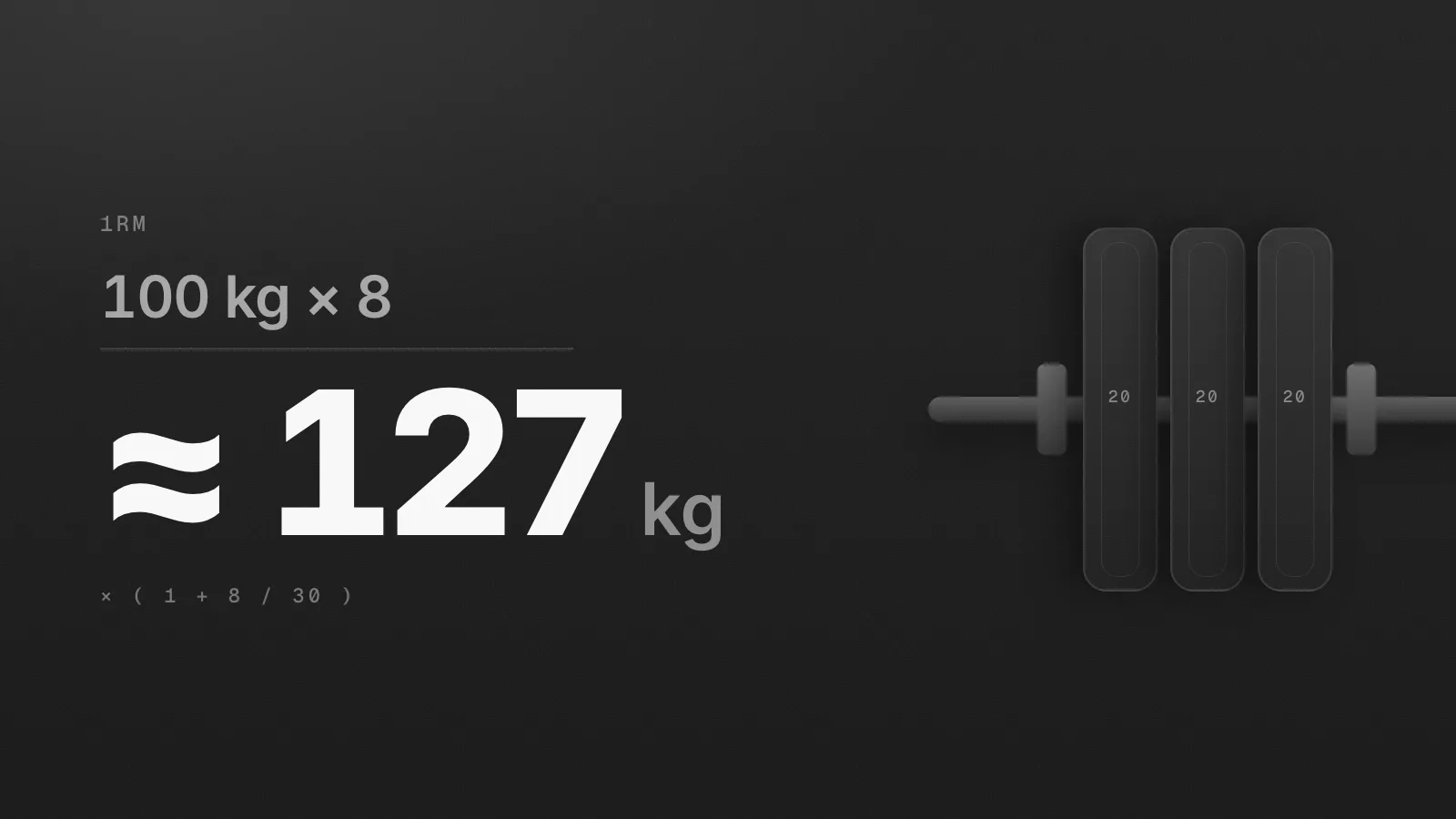
You bench 100 kg for 8 reps. Your training partner benches 110 kg for 5. Who is stronger? You could both max out and find out the hard way, or you could answer the question in ten seconds with a formula that has been around since the eighties.
That formula gives you your estimated one rep max, usually written e1RM. It is one of the most useful numbers in strength training, and one of the most misunderstood. Here is what it is, how to calculate it, why tracking it is smarter than testing your real max, and where it stops being reliable.
What is an estimated one rep max?
Your one rep max (1RM) is the heaviest weight you can lift for exactly one clean rep on a given exercise. It is the standard way to measure maximal strength.
The problem: actually testing it is expensive. Not in money, but in fatigue, risk, and time. So instead of testing it, you can estimate it from a submaximal set. Lift a weight you can handle for several reps, note the weight and the reps, and a formula converts that performance into the single-rep number it roughly corresponds to.
That converted number is your estimated 1RM. It answers a simple question: "based on what I just did, what could I probably lift for one rep?"
How does the Epley formula work?
The most widely used estimation formula is the Epley formula, published in 1985. It is short enough to do in your head:
e1RM = weight × (1 + reps / 30)
In plain terms: every rep you perform beyond the first adds about 3.3 percent to the estimate. Three concrete examples:
- 100 kg × 8 reps: 100 × (1 + 8/30) = 100 × 1.267 = about 126.7 kg
- 80 kg × 5 reps: 80 × (1 + 5/30) = 80 × 1.167 = about 93.3 kg
- 60 kg × 12 reps: 60 × (1 + 12/30) = 60 × 1.4 = 84 kg
Back to the opening question. Your 100 kg × 8 works out to an e1RM of 126.7 kg. Your partner's 110 kg × 5 gives 110 × 1.167, about 128.3 kg. Nearly identical, with a slight edge to your partner. No max attempt required.
One detail worth knowing: the formula assumes the set was taken close to failure. If you stop a set of 8 with four reps left in the tank, the estimate will lowball you. Your hardest work set of the day is the one worth plugging in.
Why track your e1RM instead of testing your real max?
Testing a true 1RM has its place, mostly in powerlifting where the max attempt is the sport itself. For everyone else, it is a poor tracking tool, for three reasons.
It costs recovery. A real max attempt is one of the most fatiguing things you can do in a gym. The days after a heavy single are days where the rest of your training suffers. Doing that every few weeks just to check a number is a bad trade.
It carries risk. Grinding a maximal rep is where technique breaks down. Under a bar, that is exactly when things go wrong. An estimate from a solid set of 5 tells you almost the same thing with none of that exposure.
It is not reproducible often enough to show a trend. You can realistically test a max a few times a year. Your e1RM, on the other hand, updates on every workout, from sets you were going to do anyway. That gives you dozens of data points instead of three, which is what you actually need to see whether you are progressing.
The mental shift is this: the e1RM is not a prediction you need to verify. It is a tracking metric. Whether your true max is 126 or 130 matters less than the fact that the same calculation said 120 two months ago.
How the e1RM lets you compare different rep ranges
This is the underrated part. Say you ran squats at 5×5 last block, and this block you switched to 3×8 with lighter weight. Raw numbers can't tell you if you got stronger: 105 kg × 5 and 95 kg × 8 don't compare directly.
Run them through Epley:
- 105 kg × 5 gives an e1RM of 122.5 kg
- 95 kg × 8 gives an e1RM of 120.3 kg
Now they live on the same scale. You held roughly the same strength level through a rep-range change, which is useful to know, and impossible to see from the raw logs.
This is what makes the e1RM the natural currency for progress on an exercise. Weight alone ignores reps. Reps alone ignore weight. Total volume rewards junk sets. The e1RM condenses each performance into a single comparable number, whatever rep scheme you happen to be running. It tracks intensity; for the other half of the picture, training volume, you would count sets per muscle per week instead.
What are the limits of the Epley formula?
An honest tool comes with an honest disclaimer. Three things to keep in mind.
It overestimates on high reps
The formula is linear: every rep adds the same 3.3 percent. Reality is not linear. Beyond roughly 10 to 12 reps, endurance starts doing more of the work than maximal strength, and the estimate drifts upward. A set of 20 at 60 kg computes to 100 kg, and almost nobody who does the first can do the second. Trust the formula in the 1 to 10 rep range; treat anything above as a rough sketch.
It behaves differently across exercises
Epley was built around barbell lifts. It behaves reasonably on squats, bench and deadlifts. On isolation work, machines, or exercises where technique and stability dominate, the weight-to-reps relationship changes, and so does the accuracy. Comparing your curl e1RM to your squat e1RM as if they were equally precise is a mistake.
It is a trend indicator, not a truth
Bar speed, sleep, how close to failure you really were: none of it enters the equation. Any single e1RM value carries noise. What is meaningful is the direction over weeks and months, computed the same way every time. One bad day means nothing. A three-month plateau means something.
What about Brzycki, Lombardi and the other formulas?
Epley is not alone. Brzycki (weight × 36 / (37 - reps)) is the other popular option and gives slightly lower estimates at moderate reps. Lombardi (weight × reps^0.10) exists too, along with a handful of others.
They all agree closely in the low rep range and diverge as reps climb. Which one is "right" matters much less than people think, for the reason above: you are tracking a trend, so what matters is picking one formula and sticking with it. Consistency beats theoretical precision.
How Gymmy uses the estimated 1RM
In Gymmy, every set you log is converted to an e1RM with the Epley formula, and your records on each exercise are based on that number rather than raw weight. So when your 92.5 kg × 6 beats the e1RM of your old 100 kg × 3, it counts as the record it actually is, and the app flags it live, on the set, mid-workout. You also get a per-exercise e1RM chart over time, which is the trend line this whole article is about.
Nothing there requires the app, to be clear. A calculator and a spreadsheet get you the same math. The app just removes the bookkeeping.
Don't test your max to know your max. Log your work sets, watch the estimate, and save the real attempts for the days that deserve them.
Frequently asked questions
How often should you test your real 1RM?
For most lifters, rarely or never. A true max attempt is fatiguing, carries injury risk, and tells you little that a hard set of 3 to 5 reps cannot. Competitive powerlifters test because the max attempt is their sport; everyone else gets a cleaner picture from an estimate that updates every time they train.
Is the Epley formula accurate for dumbbell and machine exercises?
Less so than for barbell lifts. The formula was built around squat, bench and deadlift, where the weight-to-reps relationship is fairly stable. On isolation moves and machines it still produces a usable trend, but treat the absolute number as rough and only compare an exercise against itself.
Should beginners bother calculating their 1RM?
There is no urgency. In the first months your numbers climb so fast that any set-to-set comparison already shows progress, and maximal testing adds risk with little payoff. The estimate becomes useful once progress slows and you need a single number to compare different rep ranges over time.
Why did my estimated 1RM drop even though I trained hard?
A single low reading is normal noise. Sleep, stress, food, time of day and how close to failure you actually trained all move the estimate by a few percent. Judge the direction over several weeks computed the same way each time; one low reading means nothing, a two or three month decline is worth investigating.

The author
Nicolas Pancin - Creator of Gymmy
Lifter and independent developer. I built Gymmy to log my own workouts, after years of doing it in the Notes app. I write here about self-directed training, tracking progress, and the design choices behind the app.
Follow on TikTok