
 ChatGPT
 Claude
 Perplexity
 Gemini
 Grok
Grok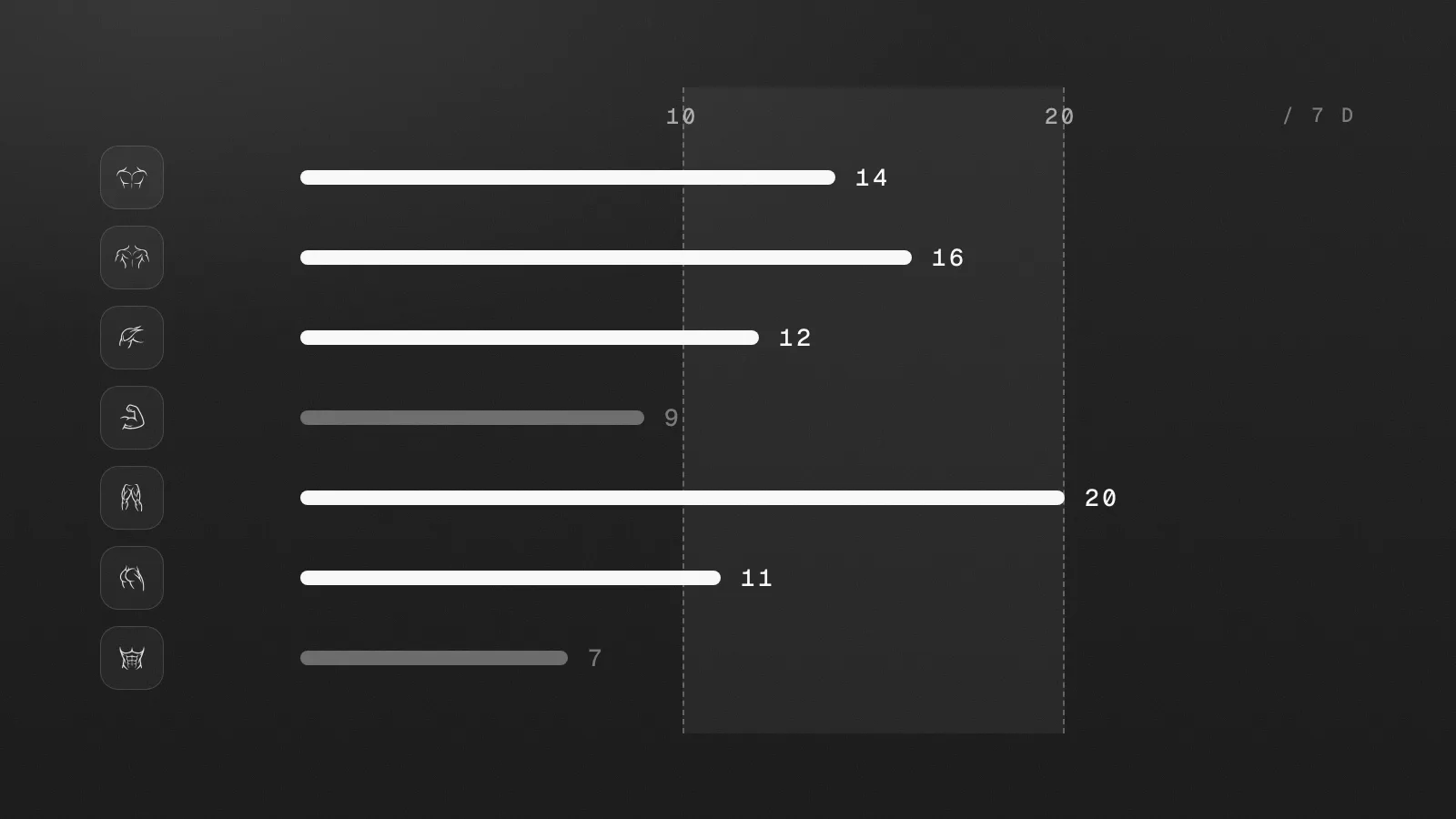
"How many sets should I do per muscle per week?" is one of the most searched questions in lifting, and one of the most dogmatically answered. Some coaches swear by minimal volume, others prescribe 25 sets of everything. The honest answer sits in between, comes with real nuance, and, more importantly, depends on a number most lifters have never actually measured: their own real weekly volume.
Let's cover what the research suggests, what actually counts as a set, and how to audit your own week before changing anything.
How many sets per muscle group per week do you actually need?
The research on training volume points to a broad but usable range: for most people, somewhere around 10 to 20 hard sets per muscle per week is where growth happens efficiently. Below that range, you can still progress, especially as a beginner or on a muscle that gets plenty of indirect work. Above it, returns diminish and recovery costs climb.
A few nuances that matter more than the exact numbers:
- Less still works for maintaining. If life gets busy, a handful of hard sets per muscle per week preserves most of what you've built. Volume requirements to maintain are far lower than to grow.
- More is a tool for specific cases, not a default. Pushing past 20 weekly sets is something advanced lifters do on one or two priority muscles for a limited block, while pulling back elsewhere. Running 25 sets for every muscle year-round is a recovery bill most people can't pay.
- Individual variation is large. Some people grow well at 10 sets, others genuinely need closer to 20. Your training age, sleep, stress and food all shift the number.
Treat 10 to 20 as a sanity-check range, not a law. The interesting work happens when you compare that range to what you're actually doing, which is where most surprises live.
What counts as a set?
The 10 to 20 figure refers to hard working sets: sets taken close to failure, with a weight that genuinely challenges you. That definition immediately excludes a few things:
- Warm-up sets don't count. Ramping up to your working weight prepares you; it doesn't drive growth. If you count your warm-ups, your volume numbers inflate by 30 to 50 percent and stop being useful. This is why a good log lets you mark warm-ups separately, and why Gymmy excludes them from volume counts automatically.
- Junk sets don't count either. A set stopped ten reps short of failure because you were chatting is not a hard set. You don't need to train to absolute failure every time, but a countable set should end within a few reps of it.
- Drop sets are worth something, but not a full set. The drop portion is done pre-fatigued with reduced weight. Counting it as half a set is a reasonable convention, and it's the one Gymmy uses: a drop set adds 0.5 to your weekly volume.
The definition matters because two lifters can both claim "16 sets of chest per week" and be describing completely different training.
How do you count sets for compound exercises?
Here's where honest counting gets genuinely tricky. A bench press is not just a chest exercise: your triceps and front delts work hard on every rep. A row hits lats, rear delts and biceps. So when you bench, how many sets did your triceps do?
If you count compounds only for the primary muscle, you'll massively undercount arms and delts. If you count them fully for every muscle involved, a push day suddenly credits your triceps with 12 sets they didn't quite earn, and you'll conclude you need no direct arm work when you probably do.
A convention that threads the needle: 1 set for the primary muscle, 0.5 for each secondary muscle. Bench press: 1 for chest, 0.5 for triceps, 0.5 for front delts. It's not physiologically exact, nothing is, but it's consistent, it errs in no particular direction, and it makes weeks comparable to each other. That last part is what actually matters: your count doesn't need to be perfect, it needs to be stable.
Doing this arithmetic by hand across a full week is tedious, which is why almost nobody does it. It's also exactly the kind of thing software should do for you: Gymmy applies the 1 and 0.5 convention automatically and shows your weekly sets per muscle across 17 muscles, with a heatmap so undertrained areas are visible at a glance.
Audit your real week, not your program on paper
This is the step almost everyone skips. Your program says 16 sets of back per week. But what happened last week, in reality?
- You skipped Thursday because of work, and that workout held 6 of those sets.
- You cut the last two sets of rows because the gym was closing.
- Two of your "back sets" were warm-ups you count out of habit.
Real total: 8 hard sets, half of what's on paper. Do this honestly for every muscle over an actual recent week and the picture is often startling: the muscles you enjoy training sit comfortably in range, while a couple of others limp along at 4 to 6 real sets, fed only by the 0.5s from compound lifts.
The audit is simple: take your last 7 days of logged workouts, count hard sets per muscle using the 1 and 0.5 rule, and write the totals next to the 10 to 20 range. If your program lives in reusable routines, also compare planned versus performed. The gap between the two is a consistency problem, separate from your volume problem, and worth knowing about.
Most stalled lifters don't have a programming problem. They have a gap between the program they think they run and the week they actually trained.
What to do when a muscle is stagnating
When a muscle stops progressing, the reflex is to hunt for new exercises or fancy techniques. Resist it, and check the boring things in order:
- Check its real weekly volume first. Nine times out of ten, the stagnating muscle turns out to be one sitting at the bottom of, or below, the effective range once you count honestly. Side delts, hamstrings and calves are classic victims: lots of indirect half-credits, little direct work.
- If volume is genuinely low, add gradually. Two or three direct sets per week, hold for three or four weeks, watch the log. Don't jump from 6 sets to 18: you lose the ability to tell what helped, and you'll be sore enough to compromise everything else.
- If volume is already 15 to 20 honest sets, more is probably not the answer. Look at effort (are those sets actually hard?), exercise selection, technique, sleep, and food. Piling volume onto a muscle that isn't recovering just digs the hole deeper.
Give changes time to show up. Volume adjustments read out over weeks, not workouts, so judge them on the month's trend line, not on Tuesday's pump.
The short version
Aim for roughly 10 to 20 hard sets per muscle per week, count only working sets taken near failure, credit compounds as 1 for the primary muscle and 0.5 for secondaries, and, before changing anything, audit a real week rather than trusting the program on paper. Volume is one of the few training variables you can measure precisely for free. Most lifters argue about the optimal number without ever having measured their own.
Frequently asked questions
Is 10 sets per week enough to build muscle?
For many people, yes. Ten hard sets sits at the bottom of the effective range, and beginners or muscles that get plenty of indirect work can grow on it. If progress stalls there for a month or two despite decent sleep and food, adding two or three weekly sets is the reasonable next step.
Can I train a muscle once a week and still grow?
You can, but it is usually not the best way to spend the same volume. Spreading 12 to 16 sets over two or three workouts keeps the quality of each set higher, because performance drops sharply late in a long session for one muscle. Once a week works; twice a week tends to work better at equal volume.
Do sets to failure count for more than normal sets?
Not enough to change how you count. A set taken to failure and a set stopped one or two reps short produce similar growth per set, while failure costs noticeably more recovery. Count any set ending within a few reps of failure as one hard set, and save true failure for the last set of an exercise if you use it at all.
Do abs and calves need as much volume as big muscles?
The 10 to 20 range is a reasonable starting point for them too, but the context differs. Calves and abs recover quickly and tolerate high frequency, and abs already work isometrically during heavy compound lifts. Most lifters do fine with direct work in the lower half of the range, done consistently rather than in bursts.

The author
Nicolas Pancin - Creator of Gymmy
Lifter and independent developer. I built Gymmy to log my own workouts, after years of doing it in the Notes app. I write here about self-directed training, tracking progress, and the design choices behind the app.
Follow on TikTok